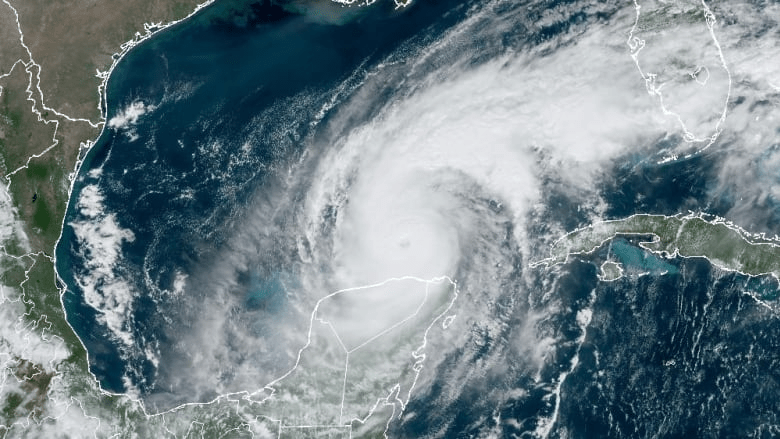
Residents of Florida, some with connections to the Maritimes, are preparing for Hurricane Milton, a dangerous Category 4 storm, set to hit late Wednesday on the heels of Hurricane Helene.
Trevor Adams, who worked for CBC News as a meteorologist in the Maritimes over the summer, lives in the Tampa Bay area.
Adams left his home early Tuesday, at around 5:30 a.m., to try to beat the traffic and get to a friend’s house in Fort Lauderdale, after people were told they should leave the area.
“It was a sea of red lights,” he said. “The roads were … packed full of people leaving.”

Adams said the storm is a “sign of the times,” explaining how the Gulf of Mexico water temperatures are the source of fuel for these extreme storms.
“It’s the price you pay for wanting to live here. But at the same time, it’s hard to comprehend how something could be so enormous and so destructive.”
Unusually warm waters brought on by the burning of fossil fuels, a practice that is leading to climate change according to scientists, is the reason behind these rapidly intensifying storms.
The U.S. National Hurricane Center said Milton is expected to make landfall on the Florida Gulf Coast late Wednesday, with winds beginning to increase along the West Coast of Florida by Wednesday afternoon.
More than a million people have been ordered to evacuate from areas in the path of the storm.
Cyndi Edwards, originally from Bathurst, lives and works in Florida as a TV host. Her residence is just outside of Tampa, and she has four vacation properties on the barrier islands.
“We’ve been in Florida since 2006 and I’ll tell you truthfully, most people are pretty nonchalant when it comes to hurricanes,” she said on Information Morning Fredericton. “They always say, ‘Oh yeah, well, never hits us directly, we’ve been lucky, I’m not evacuating,’ so on and so forth.
“Well, this time, I mean, the mayor said, if you don’t get out, you’re going to die.”
Edwards said she thinks people understood that warning for the most part, especially those in the zones closest to the coast. While Edwards’s home is in one of the less crucial zones, she is still concerned about flooding and the potential for a long stretch with no power. But her bigger worry is her island properties.

Making the storm even worse is the fact that it comes only two weeks after Hurricane Helene.
Edwards’s place on Bradenton Beach, south of Tampa, is ground level and a storm surge destroyed everything from the drywall to the floors to the appliances, which she said are still in front of the unit, along with the contents of other people’s homes and condos.
“When this next storm comes, all that stuff is just going to be projectiles,” she said.
Adams said cleanup efforts from Helene were unfortunately in vain, since it will all need to be redone once Milton hits.
He said there are garbage piles that can be compared to the snow banks that Maritimers might be familiar with in mall parking lots during the winter.

.
Adams said his mother lives in a retirement community, about 10 minutes from his home, and a number of people are walking away and not expecting to go back.
- More than 1 million people warned to get out before Hurricane Milton hits Florida
- CBC ExplainsHow dangerous is Hurricane Milton? Here’s what we know
“The sad part is, there’s a number of people that live in that community that have nowhere to go,” he said.
“They’ve been told to leave, and they’ve got nowhere to go. They don’t have family, they don’t have resources.
“We think about from Helene, the number of deaths. Well, that’s a consideration for this particular storm, Milton, you know, how many people will lose their lives? And that’s just the reality.”
With files from Information Morning Saint John, Fredericton
This story was originally published in CBC News on Oct. 9, 2024.
 Hannah Rudderham Portfolio