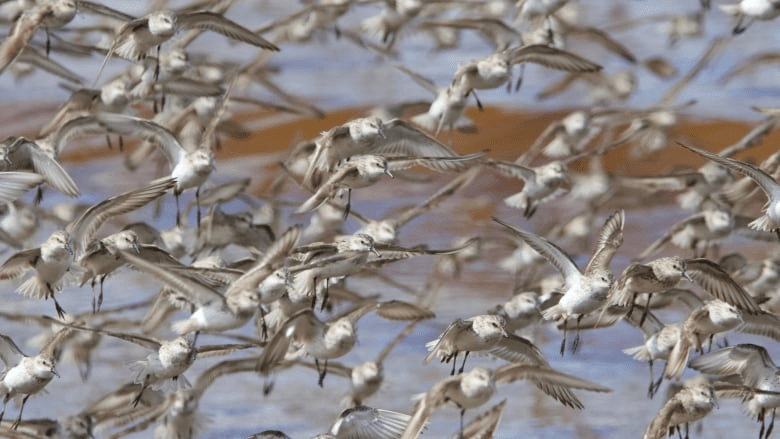
For a few weeks every summer, New Brunswickers might be familiar with the tens of thousands of migrating shorebirds crowded together at high tide on the Bay of Fundy mud flats.
That short period when the crowds of birds stop on the shore happens to coincide with another group flocking to the province.
Biologists and experts from across the Western Hemisphere and beyond are getting together at Mount Allison University in Sackville this week to discuss all things shorebirds.
One topic on the agenda will be the population’s decline.

Diana Hamilton, a Mount A professor and a biologist specializing in shorebirds, said shorebirds as a group are not doing well.
She said estimates suggest that shorebird populations have declined around 40 per cent in the Western Hemisphere, with even higher percentages possible for longer-distance migrants.
“The reasons for this are probably multiple. Shorebirds require a breeding area, a wintering area and also stopover areas. So if anything bad happens in one of those areas, it’s going to have negative implications for the birds,” she said.
“That’s why the kind of work that’s being presented this week is so important, because it allows us to look at these birds throughout their range, and it also brings together people who are focused on conservation.”
Hamilton said shorebirds rely on intertidal habitat — the habitat between the low and high tide line — but that habitat is threatened by a number of factors.
Climate change leading to sea level rise is one issue. Another, she said, is shoreline hardening, where artificial structures are built on the shore, preventing the shore from receding.
The frequency and intensity of storms is another big problem, she said.
But this population decline doesn’t mean that people won’t still be able to see the crowds of semipalmated sandpipers that stop in the province to roost.

“When you see 30,000 shorebirds, it’s still really impressive, but maybe there were 50 or 60,000 before,” said Hamilton.
“In general, the estimate is that we’ve lost probably about half the semipalmated sandpipers that came through here.
“We still can get flocks of 50, 60,000, maybe even up to 100,000 in some cases. So certainly, we hope to stop this slide. That’s part of the work that shorebird biologists are doing.”

During one evening of the conference, Hamilton said attendees will be going to the Johnson’s Mills Shorebird Interpretive Centre to see the birds on the mud flats, and she encourages others to view the sight as well.
But she said it’s important to be respectful of the shorebirds. At viewing centres like Johnson’s Mills or Mary’s Point, people will be instructed to stay off the beaches around high tide.
- 100,000 shorebirds spotted in 1 day at Johnson’s Mills Shorebird Reserve
- Shorebirds are back in Dorchester — and they need peace, conservancy says
If people go on the beach while the birds are roosting, Hamilton said they are going to be disturbed, they’ll start flying around and that will mean they can’t gain weight as fast.
“It’s a relatively short period of time that we’re talking about,” said Hamilton.
“So if people can be sensitive to the fact that birds are roosting and that they shouldn’t be disturbed, that will have a direct impact, and that’s something individuals can do.”
This story was originally published in CBC News on Aug. 11, 2024.
 Hannah Rudderham Portfolio