In the past, if students wanted to hold a sacred Indigenous smudging ceremony on a University of New Brunswick campus, they would need to contact security with three days’ notice.
But now that policy has changed, and the university has allocated designated spaces on campus for smudging and pipe ceremonies to take place at a moment’s notice.
“If someone’s here in my office and let’s say we’re having a difficult conversation and there’s emotions attached, I may want to say, ‘Do you want to take a break and let’s smudge?'” said Cheyenne Joseph, UNB’s associate vice-president of Indigenous engagement.
“And under this new policy, that can happen, because my office is a designated space, meaning smudging can happen at any time.”

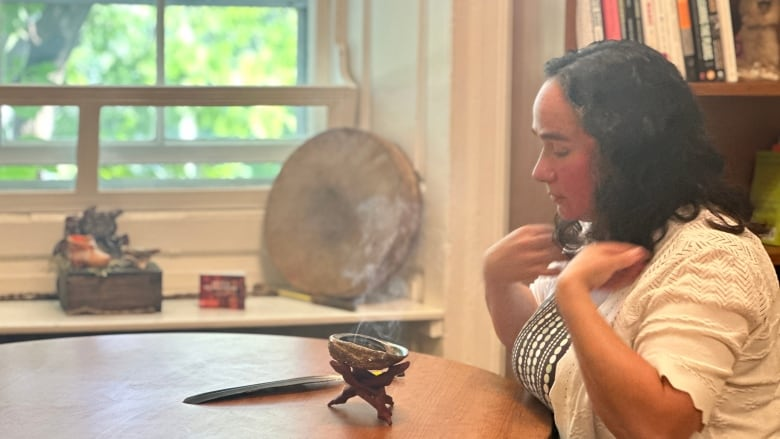
Joseph said smudging is a practice that uses the four elements of life — water, fire, earth and air.
She said smudging is used to spiritually cleanse the body or the space and is often done at the start of events or gatherings. She said the practice involves a shell, which holds the smudge and represents water, the fire which is produced by lighting the medicine, and the four sacred medicines — sage, tobacco, sweet grass and cedar — which represent the earth.
An eagle feather representing the air element is also often used, as eagles hold deep cultural significance in Wolastoqey and Mi’kmaw cultures, Joseph said.
The new policy at the university was adopted in May and the designated spaces will have a sliding sign outside the room that can be used to indicate that a smudge is in process.
Joseph said a lot of work is going into signage about the practice and culture around it. She said that will hopefully help those in the building who may, for example, smell an unfamiliar scent.
Emily Paul, a UNB student, said the policy seems to be a good thing since a lot of popular halls have designated spaces, but she hadn’t heard about the initiative until she read the news release on the university’s website.
“I have received emails about things that are going on on campus, even during the summer,” she said. “So they have been updating us with, kind of, campus happenings, but I find it interesting we didn’t get anything about this particular news release.”
In order for people to benefit from the designated smudging spaces, Paul said she thinks it is important to make sure people are aware of them.

She is also concerned that a lot of the designated spaces are classrooms, she said, and the onus is on the students to make sure there are no classes happening if they wish to hold a ceremony there.
Paul said she thinks she would use the spaces if the university offered opportunities for students to attend a smudge.
“I would definitely be interested in connecting with my culture and connecting with people who share my culture in that way,” she said.
Joseph said as the year goes on and the policy continues to be put in place, there will be flexibility to make changes if certain things aren’t working.

She said it takes awhile to have conversations around evaluating the practice but those conversations have been positive so far.
“There’s definitely lots of other work to be done,” Joseph said, noting that next year is the tenth anniversary of the Truth and Reconciliation Commission’s final report, which will likely bring about other activities and events.
“We want to be able to showcase and continue to build out the work that we’re doing to make sure that these spaces are culturally inclusive of Indigenous faculty, staff, students, visitors, and that people feel welcome to be here.”
With files from Prapti Bamaniya
This story was originally published in CBC News on July 10, 2024.
 Hannah Rudderham Portfolio