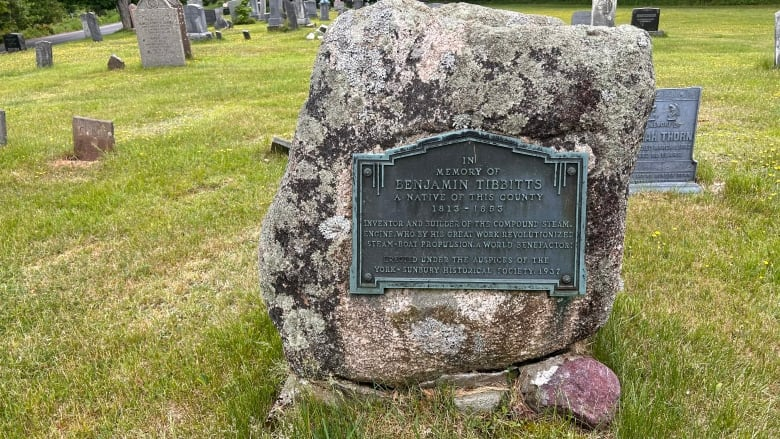
In a little graveyard on the shore of Grand Lake, a plaque marks the spot where “one of New Brunswick’s most interesting engineers” was buried.
That’s according to Moncton historian and educator James Upham, who recently paid a visit to the grave of Benjamin Tibbits in Scotchtown, a drive of about 62 kilometres east of Fredericton.
The plaque credits Tibbits, who was born in 1813, with inventing and building the compound steam engine.
Another national designation credits the Queens County native with the creation of the first marine compound engine.

But while he was amazing at what he did, those credits are not exactly accurate, Upham said.
“To say that Tibbits was the inventor of the compound steam engine is not accurate, to say he was the first person to put one in a ship is also not accurate,” he said.
But Tibbits did design and oversee the development of a compound steam boat engine, Upham said, creating what was, at that time, “the most efficient and fastest vessel on the St. John River, and one of the fastest and most efficient vessels on planet Earth.”
For 15 years, the Reindeer, which was the name of the revolutionary boat he built to house the engine, remained that way, with other companies trying unsuccessfully to build a better alternative.

When the Reindeer was taken out of commission, the engine was put into the the Antelope, and when that vessel burned too, it was put into a tugboat called the Admiral, said Upham.
“The fellow that’s buried here built one of the first successful engines that allowed people to get across the Atlantic on a regular, scheduled basis without burning gargantuan amounts of fuel,” he said.
“And the engine that he used to do it with probably outlived quite a number of the ships that were built after it to copy it — it’s really extraordinary.”
The spelling of Tibbits’s name varies in historical documents about his life. The variations include Tibbets, Tibbitts and Tibbetts, but a series of documents from 1845 uses Tibbits.
The difference between a regular steam engine and a compound one is that the steam goes into a cylinder, pushes a piston — like a regular engine — but then goes into another cylinder and pushes another piston, providing double the efficiency, said Upham.
He said some earlier records credit Tibbits as the inventor because there weren’t as many records and resources to access as a researcher at that time.

Upham said that one of the remarkable things about Tibbits is that he didn’t grow up with extensive libraries nearby and the public schooling system wasn’t great in the 1820s, but he still managed to educate himself.
Tibbits became an apprentice to a jeweller and watchmaker in Fredericton, allowing him to learn how to make things physically while watching how technology was developing around him.
“For him to be doing that from Fredericton, New Brunswick, at that point, in the 1830s, it would almost be like somebody on Mars with a telescope trying to figure out how to do stuff on Earth, just by watching it at a distance,” said Upham.
“If a young person from this area were to go and do an internship with NASA or a similar organization, then come home and build a much better spaceship … that’s basically what Tibbits did.”
Upham said Tibbits spent some time in New England learning from different shops before coming back to Fredericton and designing his engine.
In 1843, Tibbits started building the engine, but he only lived for 10 more years.
Upham said Tibbits built a shipyard after the popularity of The Reindeer, but there was a fire and some financial liability issues, which wiped out his company financially.
Around that same time, Tibbits developed tuberculosis. He died in 1853.
- ROADSIDE HISTORYA bit of Majestic history: This relic offers a glimpse into New Brunswick’s steamboat past
- ROADSIDE HISTORYScoudouc River piers were part of first railway in New Brunswick
For a long time, Tibbits was buried in an unmarked grave. It wasn’t until the 1930s that a local historical society put the plaque on his resting place.
Upham said that from the success of The Reindeer, Tibbits would have had extraordinary opportunities in front of him.
“It’s hard to say how much further he would have gone.… We’re talking about an engineering genius who was basically cut short,” said Upham.
“We’re still living in a world that is using stuff that Tibbits worked on, developed, processed. The stuff that Tibbits did leads to us being able to move stuff around on this planet in a way that we actually had not been able to do before.”
With files from Information Morning Summer
This story was originally published in CBC News on July 7, 2024.
 Hannah Rudderham Portfolio