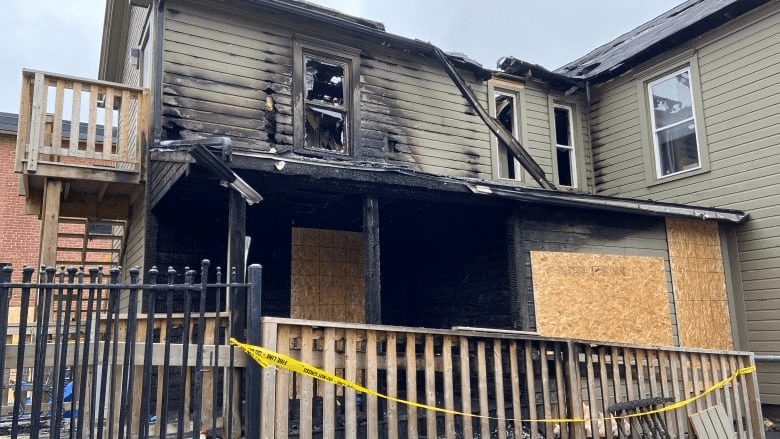
A Garrison District building in downtown Fredericton that was built nearly 200 years ago is in danger of being demolished after it was set on fire in March.
The building has undergone a fire-damage assessment to see if it could be salvaged, said a spokesperson for the Department of National Defence, which owns the building at 11 Carleton St.
But the damage “has resulted in a complete structural, architectural, electrical, and mechanical loss,” Kened Sadiku said.
Another spokesperson said “it is recommended that the building be demolished due to the extent of damage.”

The department would not provide a copy of the fire assessment report, saying it could only be released via an access to information request.
The building, which was set on fire in March, was known as the militia arms store and dates back to 1832. It was used as a hospital starting in 1882, and it became the residence for the Carleton Street Armoury caretaker in 1918, the department says.
Sadiku said in a statement that while the Fredericton Military Compound is designated as a National Historic Site of Canada, the building itself is not, “as it does not possess significant heritage characteristics.”
But John Leroux, an architectural historian in Fredericton, said it isn’t accurate say the militia arms store isn’t a designated historic site or that it doesn’t possess significant heritage characteristics.
“The military compound comprises four specific buildings, and it’s even listed on the plaque that the militia arms store is … one of those,” he said.
“It lists that building in the exact same capacity as the other three buildings there. And [the designation] speaks specifically about the character-defining elements of the militia arms store.”

The Parks Canada National Historic Site of Canada designation for the Fredericton Military Compound can be found online and says that only four buildings remain from the original British garrison, including the militia arms store. It says the buildings are representative of early 19th century British military architecture.
The designation lists key elements that contribute to the heritage and character of the militia arms store such as its rectangular wooden two-storey massing, its steep roof, balanced facade and inset chimneys.
“If it was torn down, the national historic site designation of the military compound would be radically transformed and cheapened,” said Leroux.

The City of Fredericton is not involved in the ownership of the building but it was renting it at the time of the fire. The city did not provide an interview for this story.
Leroux said when looking at the outside of the building, much of the architectural value is still visible.
He said he wishes the Department of National Defence would speak to others who have a stake in historic downtown buildings and make sure that the right experts are consulted regarding the importance of heritage buildings.
On top of the architectural value of the old militia arms store, it also holds extensive military history, he said.
- Man charged with intentionally starting fire in Fredericton’s Garrison district
- Fire at historic downtown Fredericton building deemed suspicious
Tearing down the building would leave a hole in downtown Fredericton, Leroux said.
“We need to do better than this,” he said. “There should be no reason not to try harder to salvage that building. It’s easy to say ‘tear it down,’ but what then? Then, the city is that much poorer for it.
“It’s one of the most important buildings in Fredericton.”
With files from Oliver Pearson
This story was originally published in CBC News on July 10, 2024.
 Hannah Rudderham Portfolio