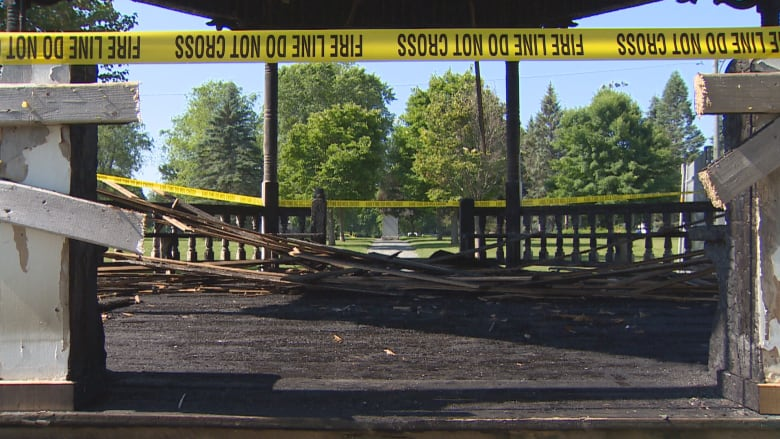
The Wilmot Park Bandstand in Fredericton is a place of memories for many. For Mavis Doucette of Hanwell, it was the spot where her late husband proposed to her 51 years ago.
And on Wednesday afternoon, she took a trip to the park with a friend to reminisce after hearing about a fire at the park’s gazebo.
“He came down one weekend to visit me, and we were in the gazebo,” Doucette said of that day in August 1973.
“We were both going to go our separate ways and go to different locations. But he asked me to marry him, and I said, ‘Yes,’ and we never left Fredericton.”

Late Tuesday night, the Wilmot Park gazebo went up in flames. According to Dave McKinley, the assistant deputy fire chief, crews were called to the site just before 11 p.m. and by the time they arrived, the fire had spread to the attic spaces.
They pulled down the ceiling to access the fire, he said in an email, and the fire investigator conducted a preliminary investigation at the scene.
City of Fredericton spokesperson Elizabeth Fraser said that preliminary investigation determined the fire was set, and Fredericton Police are now investigating.

The gazebo, which is located across from Government House, was the first domed or covered bandstand in Fredericton, Fraser said.
Restoration work on the gazebo was scheduled for this summer, she said.
While the fire made its way into the roof of the bandstand and charred much of its facade, it didn’t burn to the ground, and Fraser said city crews are working with a structural engineer to determine next steps.

Jeremy Mouat, the president of Fredericton Heritage Trust, said the bandstand is a place of history.
In 1860, the Prince of Wales, who later became King Edward VII, was visiting Fredericton and officially declared the land a park. At the time, the park was essentially a meadow, owned by a citizens’ group, and not much was done with it until it was bought by Edward Henry Wilmot in 1894.

Years after the prince’s visit, Wilmot gave the land to the city, which then took it on and began to build the park that exists today, including the now-burned bandstand.
Bandstands, as the name suggests, were there for bands, said Mouat. It’s easy to forget, he said, but before the 1930s, dance halls and bandstands were the only places to listen to live music.

While it functioned as a musical venue, it was also just a place for kids to play growing up.
“There’s a lot of sort of informal memories of birthday parties and listening to music that are wrapped up in the charred shell of the bandstand,” he said.
It isn’t the first historic structure to be set on fire in recent months either. In March, a fire was intentionally set in Fredericton’s historic Garrison district. The building, constructed in 1832, was known as the militia arms store.

And when he hears about these historic structures going up in flames, Mouat’s first reaction “is always to scratch my head and think ‘another heritage crime scene,” he said.
“Every time these buildings are damaged, it’s always a struggle to make sure that they’re renovated and repurposed … so that they can continue to have a purpose, so they continue to be part of the city that we see, the streetscapes of the city.
“Losing this building, the bandstand, is to lose memories of an earlier time.”

For Doucette, even if the now-charred structure is restored, she said she doesn’t know if it will be the same. For her, she said the gazebo represents the beginning of a happy life with her husband, whom she lost in 2020.
“I think of him every minute of every day,” she said.
“To tell you the truth, that’s why I came today and sat under my tree to watch the gazebo, because it’s another little piece of my husband and I’s history that’s gone.”
This story was originally published in CBC News on July 3, 2024.
 Hannah Rudderham Portfolio