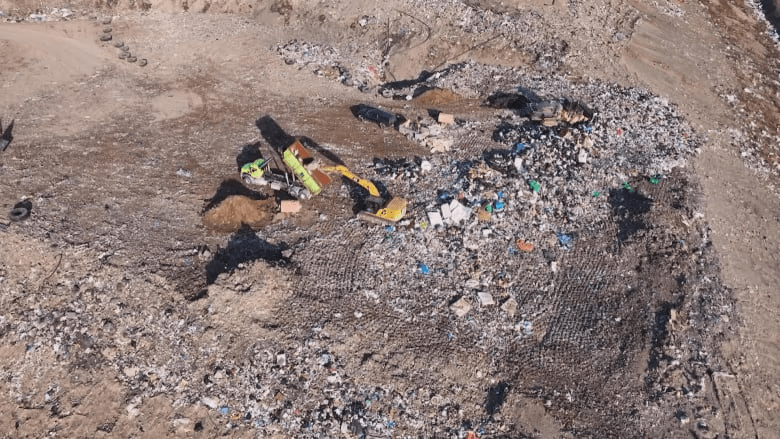
Saint John’s Crane Mountain Landfill expansion project is not sitting well with the landfill’s watchdog group.
John Doubt, chair of Crane Mountain Landfill Enhancement Inc., said the committee believes that an expansion of the landfill will put increased pressure on the landfill liner, furthering the risk of leakage into the groundwater.
Crane Mountain Landfill Enhancement is a community environmental committee that monitors the operation of the site, listens to and reports to residents of the community and reports residents’ views to the environment minister.
“Our concern is that there is a greater chance of leakage of the leachate, which is the liquid that forms at the base of a landfill, and it’s that leakage that is a really strong contaminant,” he said.

The plan is to extend the lifespan of the site to 2070, by expanding the current approved height of 90 metres above sea level to 117.5, which is about 385 feet.
Although the proposal review is underway, on Tuesday night the enhancement committee held an information session to relay the committee’s concerns to the public, a task that is part of its mandate.
The meeting included a presentation from the engineering group, EXP Services Inc., which has worked with the committee on the monitoring of the landfill since 2005 and has experience with landfill design and construction.
John Sims, a representative from the engineering firm, told the meeting that concerns about the expansion include the potential for leakage, the odour of the landfill and its appearance.
In an interview with CBC News, Marc MacLeod, the general manager of the landfill for the Fundy Regional Service Commission, said he isn’t concerned about leakage.
The liner system, he said, consists of natural marine clay beneath a high-density polyethylene plastic liner.
“Not only does any water have to get through the plastic containment, it also has to get into the marine clay containment and that marine clay doesn’t allow water to migrate through it very quickly,” he said.
“We’re talking into the realm of 50 to 100 years before water could penetrate it. So would it leak through? Possibly, I can’t give 100 per cent guarantee on anything. But the likelihood is minimal.”
Doubt said the greatest concern expressed was about the smell of the landfill.
“They drive by it all the time, it gets into their backyards, it’s there all the time for them,” he said.
MacLeod said currently, the landfill is working to install the latest technology in gas recovery, to reduce odour as much as possible.
At the Crane Mountain Landfill, they drill into the garbage to recover landfill gas, which is what causes the smell, and use it for electricity production.

During COVID, the process was stalled, but began again on Nov. 7, 2023. Since catching up, MacLeod said the odour is a less prevalent issue.
Before the maximum height of the landfill can be increased, the plan must undergo an environmental impact assessment process.
According to the Department of Environment’s website, an environmental impact assessment identifies harmful environmental effects that could result from the proposed project and reduces or mitigates potential effects before they happen.
Part of the assessment process, said MacLeod, requires public consultation, of which a virtual and an in-person session were held a few months ago.

The concerns expressed at those public consultations, he said, which include some of those brought up at this week’s information session, were submitted to the technical review committee. The government can then come back to the service commission and request more information or ask questions.
Listening to monitoring group
MacLeod said questions and concerns brought forward by the monitoring committee are taken seriously. He said the service commission provides annual funding to the committee in order for it to provide and gather information about the operations of the landfill.
“A lot of our decisions are based on the feedback we do get from [Crane Mountain Landfill Enhancement Inc.], so it’s been a great working relationship that way,” he said.
“But, you know, no one likes a landfill. We’re unfortunately a necessary evil but we do the best we can do to address the concerns and … find the best option for the region.”
With files from Information Morning Saint John, Graham Thompson
This story was originally published in CBC News on March 20, 2024.
 Hannah Rudderham Portfolio