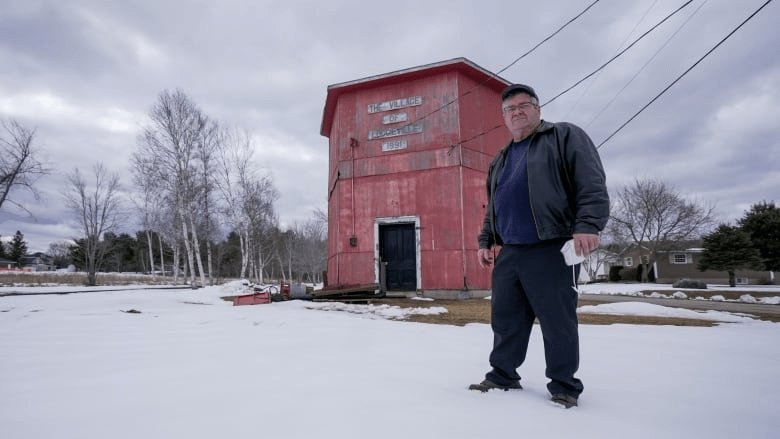
On a dead-end street in the former village of Loggieville, a dark-red, six-sided building stands out as the only structure on a long, empty lot.
The neglected building, with its rough paint job and faded lettering, belies its historical importance to the town’s rail service. It’s also the highly sought object of attention for one resident who lives across the street.
William Walsh has tried to acquire the former Loggieville water tower before. He says this is his last attempt.
The property, formerly home to the end of a Canadian National Railway branch line, includes a small parcel of land with an old water tower once used by the railway to provide water for steam engines.
Walsh isn’t sure what he’ll do with the tower if he gets it, but he’s thinking it could be used for a one-bedroom apartment or just storage.
His main goal is to see the tower stay standing. Water towers are, after all, a rarity in Canada.

Walsh, who has operated his business — W. B. Walsh Ltd. — in the area for more than 45 years, said Loggieville, now part of the city of Miramichi, used to be a hub of industry.
“The only thing left from those days is the big barn at the end of the street and the water tower,” said Walsh.
“It meant a lot to me. I’d like to save it and repurpose it so that it’ll be here for other people.”
Steve Boyko, a railway historian and former New Brunswick resident, said the water tower in Loggieville once served as a spot for trains to refuel for the return trip after dropping off freight and passengers.
He said steam engines had coal-burning boilers to heat the water, turning it into steam to power the train.
But the last mainline steam engine in Canada was in 1960, said Boyko, so the once-common water towers and coal docks were mostly torn down.
Aside from the water tower, he said there’s little evidence there was ever a railway in Loggieville.
“As a historian, I like to see any remembrance of a railroad, any memory of a railroad preserved,” said Boyko.
“I think it is important to preserve these, especially things that are quite rare, like water towers.”
Big fixes required, if acquired
Walsh said the water tower needs major fixing. He said the roof leaks and the building is overrun with squirrels and pigeons, despite his attempts to keep them out.
But the fix will be costly. He said a conservative estimate to fix it up is $100,000.
Over the last 20 years, he and some others in the neighbourhood have tried to maintain the building and the lawn around it.

In fact, Walsh said he even has the keys to the tower, after the province came to check on it once and told him he was doing such a good job, that he should just keep the keys.
Walsh said the province has been very co-operative, but he thinks it will take some time to actually take possession of the tower, if he’s approved.
“It’s in rough shape, it’s going to cost a lot of money to fix it, but it’s a part of history that meant a lot to me as a child growing up here,” he said.
“We’re gonna make it happen.”
Owned by the province
The property is owned by the province, and Walsh said he’s been unsuccessful so far in acquiring it.
The land falls under the control of the Department of Natural Resources, according to Department of Transportation and Infrastructure spokesperson Tyler McLean.
But the property services branch of DTI is “responsible for the acquisition, disposal, leasing, management and marketing of government-owned property,” according to a government web page.

Natural Resources spokesperson Nick Brown said a municipality or members of the public can make an application to acquire infrastructure on Crown land.
If an application is approved, the property can then be declared surplus.
Surplus property is first offered to other government departments, and if there’s no interest, it may be offered to municipalities at market value, according to the government page. If there’s still no interest, it may be offered for sale by public tender at market value and adjacent landowners are notified.

Neither Brown nor McLean would clarify which department is responsible for approving or denying applications.
This time, Walsh sought a letter of support from the City of Miramichi to help make his case to take over the water tower.
According to the report from the city, council voted to write a letter of support because the parcel of land that Walsh wants is “adjacent to the northern side of the rail bed” and it “would not impact public use.”

Paddy Quinn, the deputy mayor of Miramichi, said it was a unanimous decision to support Walsh’s work to acquire the property.
“It’s a bit of a no-brainer on our end,” said Quinn.
“It’s in our city, we have no intended municipal use for any part of that area — the trail line runs through there, but doesn’t affect any of that — and it’s a feel good story as far as we’re concerned.
“Of course, we wanted to see it preserved.”
With files from Prapti Bamaniya
This story was originally published in CBC News on March 19, 2024.
 Hannah Rudderham Portfolio