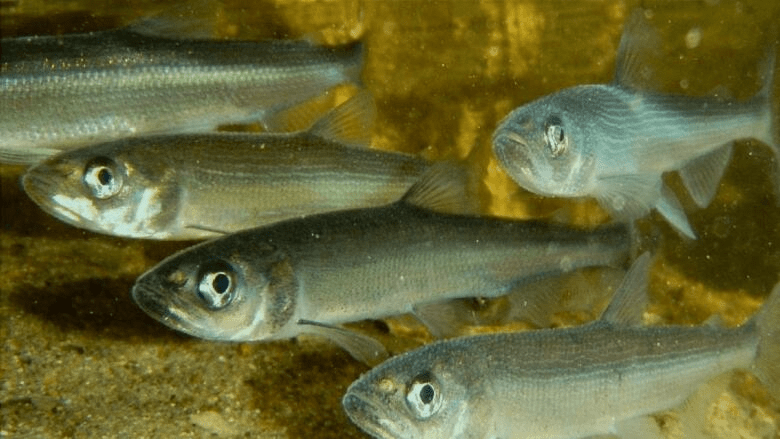
In the Magaguadavic watershed in southwestern New Brunswick, there’s one lake that is home to a unique pair of rainbow smelt populations.
And it’s the only home for them in the world.
That’s why classifying Lake Utopia as a key biodiversity area was a “no-brainer” for those looking into the fish.
Key biodiversity areas are identified by the Wildlife Conservation Society of Canada, and areas need to meet criteria either on a national or global scale.

Ciara Raudsepp-Hearne, the society’s director for key biodiversity areas, said Lake Utopia clearly fit the criteria. But then came the hard work of finding experts in the particular species, estimates of the population numbers, and information about the biology and threats to the system.
“It’s a very data heavy process where we fill in a very long and detailed proposal form,” said Raudsepp-Hearne.
“And that has to be then reviewed by additional external experts. And then we … send it out to stakeholders and rights holders, that includes landowners and governments and Indigenous communities.
This process takes about a year, before the work can be submitted to a national committee for acceptance.
Now, Lake Utopia has officially received its designation because of its rainbow smelt.
The small-bodied and large-bodied populations of Lake Utopia rainbow smelt, which co-exist in the lake, are listed as endangered according to the committee on the status of endangered wildlife in Canada. They were designated as threatened in 1998 and 2008, respectively, but the status of both populations was re-examined in 2018.
Fish from one population typically don’t breed with fish from the other, and they spawn in separate streams that feed Lake Utopia, said Colin Chapman, the Atlantic Canada KBA co-ordinator for the Wildlife Conservation Society of Canada.

Chapman said these fish are genetically and ecologically isolated from other rainbow smelt, which gives them their own evolutionary lineage.
“That’s why there’s attention drawn to them because they’re effectively separated from other rainbow smelts,” he said.
“If we were to lose these, then we lose that branch of evolution within rainbow smelts.”
Chapman said there are other key biodiversity areas in the province that people might see every day and not know about.
They include Fundy National Park, which is home to threatened vascular plants and threatened and geographically restricted fungi and lichens.

Other examples in New Brunswick are Fox Island near Miramichi Bay, Peters River west of Bathurst, and the Grand Manan Archipelago.
Sean Blaney, the senior scientist and executive director for the Atlantic Canada Conservation Data Centre based in Sackville, said his organization is heavily involved with the Wildlife Conservation Society.
He said the centre’s data is one of the major sources for the society to determine whether a site fits the bill as a key biodiversity area.
“We get to have sites designated … based on the information that we’ve collected in the field or compiled from other sources.
Paula Noel, the New Brunswick program director with the Nature Conservancy of Canada, said the conservancy has provided input in the past to the Wildlife Conservation Society, especially for areas where the conservancy has worked and has specific knowledge.

Noel said the different conservation organizations working in the province often have separate focuses. For the conservancy, she said, the focus is on land acquisition and permanent conserved areas, while other groups focus more on outreach and education.
But she said having certain areas in the province designated as key biodiversity areas will help the conservancy in the future.
“You know, making sure that the work we’re doing and, you know, the funds that our donors are contributing, that we’re investing them in the most important areas to make the biggest impact on conservation,” said Noel.
Raudsepp-Hearne said the goal of the key biodiversity area designations is to attract national, and even global, attention.
However, the key biodiversity designation is just that, a designation, and it doesn’t include any legal protection for the area.

Raudsepp-Hearne said scientific groundwork is being done to identify these areas, the Wildlife Conservation Society is also actively working to bring together government, Indigenous communities and NGOs, so more resources can be put toward protecting the biodiversity of those areas.
But making something a protected area isn’t always the right answer, she said.
“Sometimes that’s the right approach, but often, it’s more to do with community stewardship, or developing other approaches or regulations or policies to make sure that the biodiversity is safeguarded,” said Raudsepp-Hearne.
“These key biodiversity areas are on public land, but they’re also on private land. They’re on Indigenous traditional territories, they are in urban areas, they’re in agricultural areas. So it’s important that we don’t go in and say, ‘This is what you need to do now.’ But everybody needs to pay attention to these sites.”
This story was originally published in CBC News on Nov. 26, 2023.
 Hannah Rudderham Portfolio