During the pandemic, Barine Ngbor started to see the world from a different point of view.
“I started noticing things that probably were there, but I never took it into consideration or thought too much about it,” the 22-year-old Mount Allison University graduate said.
“I would see the microaggressions and racism people of colour face in Canada. I feel like during the pandemic that skyrocketed, or it was always there, but like the pandemic shoved in our face.”
Ngbor moved to Sackville in 2018 from Port Harcourt, Nigeria. She went on to study biochemistry and psychology before moving to Moncton this year following graduation.

While completing her degree, she also started writing a children’s book, something that she thought would come later in her career, despite having written since she was six years old.
But her life in Canada inspired an earlier start to her goal.
“I knew I was Black, but coming here I registered … that’s now part of my identity. In Nigeria. It wasn’t. I was Igbo and Ogoni. I was other things first, like I was a friend, a daughter, a student before that part of my identity,” she said.
“It was just weird people saying things like, ‘Well I don’t see colour, I don’t see colour.’ But I do see colour, I see the difference between all of us. And I think that’s the beauty of the world.”
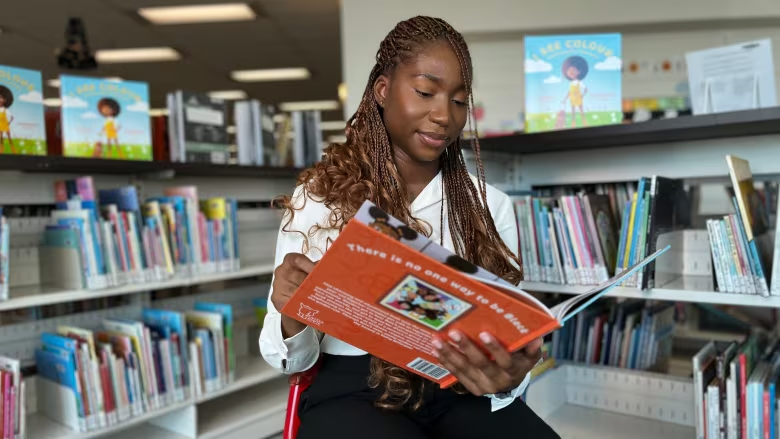
That experience inspired the title of her book, I See Colour: The Amazing Life of Bolu Davis — a children’s book that touches on humanity’s differences.
The main character, Bolu Davis, is an eight-year-old Nigerian-Canadian girl who has friends and classmates with different life experiences, cultural backgrounds and appearances.
The book has characters with albinism and vitiligo, which Ngbor used to tell readers that there’s no one way to be Black.
The journey to publication
With the help of a university grant, Ngbor was able to hire an illustrator for the book — Erica Metta, a friend of Ngbor’s from secondary school.
After that, Mount Allison’s experiential learning office suggested Ngbor connect with a small publishing house in Fredericton, Monster House Publishing.

Going through a small publisher means a smaller promotional budget, said Ngbor, so she’s had to repeatedly talk about the book since it came out in order to promote it.
“Sometimes when I get in my head a bit, I’m like, ‘It took you two years to do this. So if you have to talk about it 10,001 times, I will talk about it 10,001 times.'”
Since being published, reaction to the book has been great, Ngbor said. She held a launch event at Mount Allison, has done readings at the Moncton and Fredericton public libraries, and has even seen her book on display walking by a bookstore in Sackville.

Her family has also been supportive.
“I’m very grateful for my parents, like they support me in everything I do.… But from where I come from … you have to be an engineer, a doctor, a lawyer, and the main important thing for them was [if I am] able to stand on my own feet,” said Ngbor.
“After publishing this book, there was an additional sort of respect, I guess, like, ‘Oh, wow, she’s actually serious about this.’ And it’s now, ‘Let’s see how far this will take you.'”

Ngbor hasn’t been back to Nigeria since 2019, and although she misses it a lot, she’s also enjoyed her time in the Maritimes.
Still, Ngbor doesn’t know what the year will bring. In the meantime, she’s working on a collection of children’s stories, and her second children’s book which is about grief.
“One thing I know for sure is that New Brunswick as a whole, or like the Maritimes as a whole, would always feel like home,” said Ngbor.
“I’d love to experience other things life has in store for me. But I believe wherever life would take me, I would somehow circle back here.”
This story was originally published in CBC News on Oct. 14, 2023.
 Hannah Rudderham Portfolio